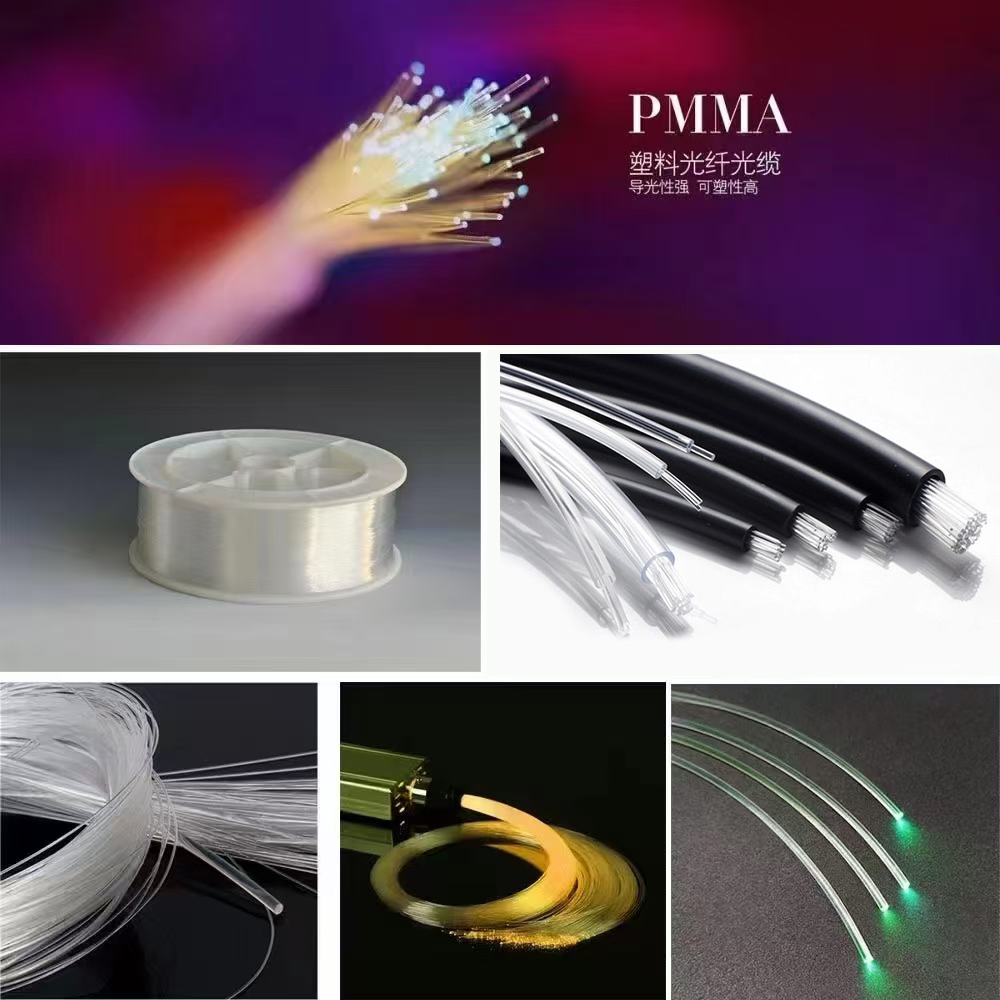
Choosing the right plastic optical fiber (POF) is a task that requires comprehensive consideration of multiple factors. Plastic optical fiber, with its advantages of low cost, easy connection, good flexibility, and impact resistance, is widely used in short-distance data transmission (home networks, automotive, industrial sensors), lighting, and decorative applications.
Below is a detailed guide to help you make the right choice based on different application scenarios and needs:
I. Core Performance Parameter Considerations
What is Attenuation (Loss): The power loss of an optical signal during transmission in an optical fiber, measured in dB/km. Lower values are better.
How to Choose:
Extremely Low Loss POF (e.g., CYTOP® material POF): Attenuation can be as low as ~10 dB/km. Suitable for long-distance (hundreds of meters) or data communication with high signal integrity requirements, such as industrial buses and high-end audio/video transmission.
Standard PMMA (polymethyl methacrylate, i.e., acrylic) POF: Attenuation is approximately 150-200 dB/km. Suitable for short-distance (within tens of meters) applications such as consumer electronics, in-vehicle networks, and decorative lighting.
PS (polystyrene) core POF: Higher attenuation, typically used only for very short-distance lighting or toys.
What is bandwidth? Bandwidth: The data transmission capability of optical fiber, measured in MHz*km. A higher value indicates a higher supported transmission rate.
How to choose: Standard step index (SI) POF: Lower bandwidth (approximately tens of MHz*km), suitable for transmitting 10-100 Mbps data, such as DMX512 lighting control and low-speed sensor signals.
Graduated index (GI) POF: A special process makes the fiber core refractive index parabolic, significantly increasing bandwidth (up to GHz*km). This is key to achieving 100 Mbps, Gigabit, and even 10 Gigabit Ethernet (such as IEEE 802.3bv 1000BASE-RH), suitable for high-speed data networks.
What is numerical aperture (NA)? Represents the angular range of light received and transmitted by the optical fiber. A larger NA indicates stronger light-gathering capability and more lenient requirements on the angle of the incoming light.
How to Choose:
High NA (e.g., 0.5-0.6): Easy to couple (minor impact of misalignment), suitable for lighting, decoration, sensors, and applications with less demanding connector requirements.
Lower NA (e.g., 0.3-0.4): Typically paired with GI-POF, offering higher bandwidth, but requiring more precise alignment, suitable for high-speed data communication.
Common core diameter specifications: 0.25mm, 0.5mm, 0.75mm, 1.0mm, and even larger.
How to Choose:
Large core diameter (e.g., 1.0mm): Easiest to connect, can be cut and terminated with hand tools, strong resistance to bending and vibration, ideal for automotive wiring harnesses, industrial applications, and DIY projects.
Small core diameter (e.g., 0.25mm): More flexible and smaller, but requires more precise equipment (e.g., ceramic ferrules), often used in compact devices or applications with limited space.
II. Select by Application Scenarios (Quick Reference)
Application Areas | Typical Requirements | Recommended POF Types | Key Considerations |
Home/Office Short-Range Networking | 100Mbps/Gigabit Ethernet, distance <100 meters | GI-POF (Graded Index) | Bandwidth, attenuation. Ensure support for target rates (e.g., 1000BASE-RH). |
In-Vehicle Networking | High reliability, vibration resistance, easy installation, short distance | Large Core Diameter (1mm) SI-POF | Connectivity convenience, mechanical strength, temperature tolerance (-40°C to 105°C). |
Industrial Automation and Sensors | EMC immunity, stable signal, complex environments | SI-POF or GI-POF | EMI/RFI resistance, chemical resistance, mechanical durability. |
Lighting and Decoration | Vibrant colors, uniform light distribution, flexible shaping | Large Core Diameter PMMA SI-POF | High NA (excellent light gathering), transmittance, color options, flexibility. |
Audio/Video Transmission (A/V) | High fidelity, EMC-free, medium-to-short distances | Low Attenuation GI-POF or Premium SI-POF | Attenuation, bandwidth, signal integrity. |
Medical Endoscope Lighting | Biocompatibility, flexibility, high brightness | Special Medical-Grade POF | Biological safety, minimal bend radius, high luminous output. |

III. Environmental and Mechanical Properties
Temperature Range: Ensure POF's operating temperature aligns with the application environment (e.g., high temperatures in automotive engine compartments, low temperatures in outdoor winter conditions).
Chemical Resistance: In industrial or specialized environments, resist corrosion from oils, solvents, etc.
Mechanical Strength: Focus on tensile strength, bending resistance (minimum bend radius), and impact resistance. POF with larger core diameters is typically more robust.
Flame Retardancy Rating: In construction, aerospace, automotive, and similar sectors, compliance with standards like UL94 V-0 may be required.
IV. Connection and Installation Costs
Connector Types: Common POF connectors include SMI, MTP, and self-locking types. Select types compatible with existing systems or market mainstream options.
Termination Tools: Large-core POF requires only simple cleavers, while small-core or GI-POF may need specialized polishing and curing equipment. Evaluate installation and maintenance convenience versus cost.
Light Source Matching: POF typically pairs with LED or laser diode (VCSEL) light sources. Ensure the fiber's transmission window (e.g., 650nm red light, 850nm/1300nm near-infrared) matches the light source wavelength for minimal loss.
Selection Process Summary
Define Requirements: Identify core objectives—data transmission (rate? distance?) or light transmission (illumination? decoration?).
Define Key Metrics: Determine attenuation based on distance, bandwidth based on data rate, and core diameter/NA based on installation constraints.
Match Type: Prioritize GI-POF for high-speed data; favor large-core SI-POF for simple connections, lighting, or automotive applications.
Verify Environmental Compatibility: Assess temperature, chemical, and mechanical requirements.
Evaluate Total Cost: Consider not only fiber cost but also connectors, termination tools, and full lifecycle installation/maintenance expenses.
Consult Suppliers: Share your specific application details with professional POF suppliers. They can provide the most suitable product samples and technical support.
Tip: For most consumer and industrial short-range applications, 1mm diameter PMMA SI-POF is often the preferred starting point due to its unmatched connection convenience and sufficient performance. Only upgrade to GI-POF or CYTOP® POF when you have clear requirements for higher bandwidth or longer distances.